

(KeepPrivate WHITE PAPER REPORT)
BY
Dan E.
INTRODUCTION
In today’s interconnected world, where digital technologies permeate every aspect of our lives, the issue of online privacy has emerged as a critical concern. With the exponential growth of data collection, users face increasing risks to their personal information and privacy. From social media platforms and online shopping to financial transactions and healthcare records, the digital landscape is teeming with opportunities for data breaches, surveillance, and unauthorized access. The pervasive nature of online privacy concerns has ignited a call for action to protect individuals’ rights and secure their digital lives.
Addressing online privacy issues is significant for individuals, society, and the digital economy. The consequences of compromised privacy can be severe, ranging from identity theft and financial fraud to reputational damage and psychological harm. The misuse and unauthorized sharing of personal data can lead to discriminatory practices, manipulation, and erosion of trust in digital services.
Safeguarding online privacy is essential for maintaining the principles of autonomy, fairness, and human rights in the digital space. Furthermore, ensuring a secure and privacy-respecting environment encourages trust among users, promotes innovation, and enables the responsible use of data for societal benefits.
This paper examines the efforts of American-based nonprofits, universities, and organizations in tackling online privacy issues, including their framework, processes, and contribution to creating awareness for resolving the problem.
EFFORTS OF AMERICAN-BASED NONPROFITS IN TACKLING ONLINE PRIVACY ISSUES
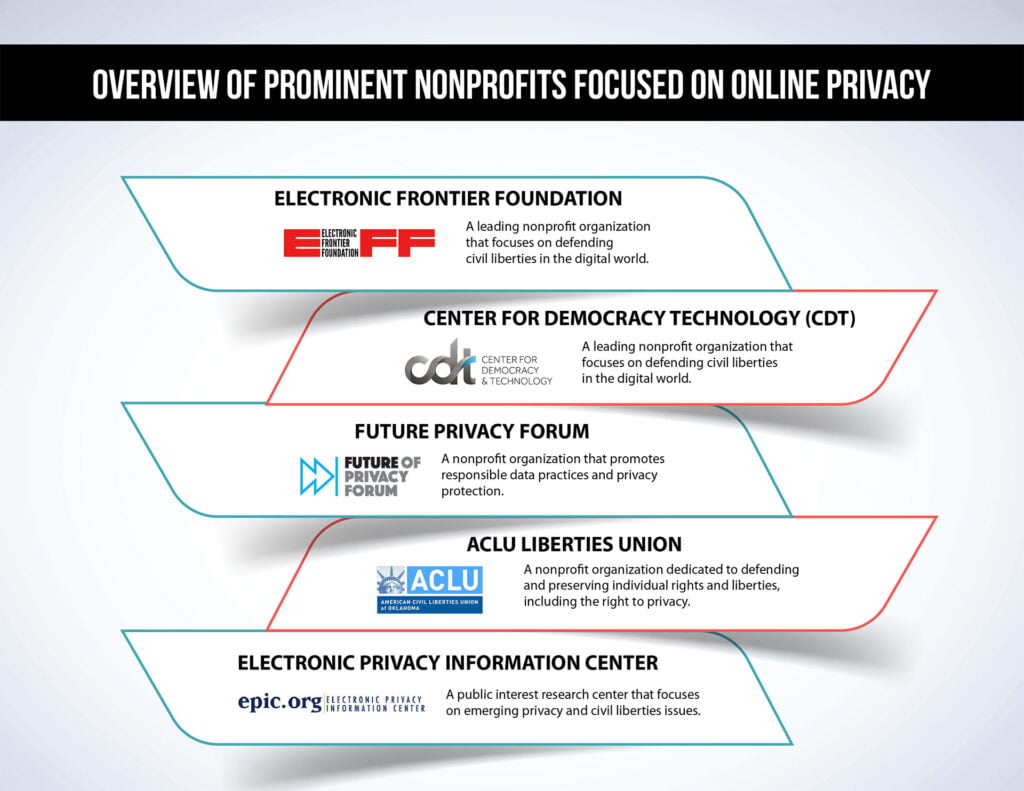
American-based nonprofits are crucial in addressing online privacy concerns and advocating for individuals’ digital rights. This is an overview of some prominent nonprofits dedicated to safeguarding online privacy.
In light of the escalating concerns surrounding online privacy, it is imperative to explore the initiatives undertaken by American-based nonprofits, universities, and organizations to address these issues. This research paper delves into the comprehensive landscape of online privacy and focuses on the specific efforts made by these entities to tackle the challenges at hand. We can gain insights into the strategies employed to protect individuals’ privacy rights and mitigate risks by investigating their frameworks, processes, and approaches. Additionally, the paper analyzes their contribution to raising awareness about online privacy and fostering a privacy-conscious culture. Through this exploration, we aim to gain a deeper understanding of the multifaceted aspects of online privacy and shed light on the significant role played by American-based nonprofits, universities, and organizations in addressing these concerns.
- Electronic Frontier Foundation (EFF): EFF is a leading nonprofit organization that protects civil liberties in the digital world. It protects individuals’ privacy rights through litigation, policy advocacy, and public education. From its establishment in 1990, EFF has remained steadfast in undertaking important cases, confronting formidable adversaries, and attaining groundbreaking triumphs. EFF has emerged victorious in legal battles against the federal government, the FCC, the largest entertainment conglomerates worldwide, and prominent electronics corporations, among various others. Moreover, EFF has defeated proposed legislation in Congress and pressured companies to uphold and honor rights.
- Center for Democracy & Technology (CDT): CDT advocates for privacy protections, free expression, and open internet. It engages in research, policy advocacy, and collaboration with industry stakeholders to develop privacy-enhancing technologies and advocate for privacy laws. CDT stands as a stalwart defender of global online civil liberties and human rights, actively shaping policies that uphold an open, innovative, and unrestricted internet. As a nonprofit organization, CDT revolves around safeguarding the internet’s user-controlled nature and advocating for the freedom of speech. It endorses legislation, corporate policies, and technological solutions that safeguard internet users’ privacy while advocating for stronger legal restraints on government surveillance.
- Future of Privacy Forum (FPF): FPF is a nonprofit organization that promotes responsible data practices and privacy protection. It facilitates collaboration between industry, academia, and policymakers to address privacy challenges and develop best practices. FPF acts as a unifying force, bringing together industry leaders, academics, consumer advocates, and influential thinkers to confront the challenges presented by technological innovation. It aims to develop privacy safeguards, ethical standards, and viable business practices. Through extensive research, publications, educational gatherings, expert testimonies, and other relevant initiatives, FPF collaborates with organizations and governments to shape exemplary policies and best practices, both within the United States and globally. FPF serves as a platform for experts to foster collaboration and advance insightful research on data protection, focusing on maintaining the utility of data. The initiatives undertaken by FPF have tangible effects on consumer privacy in the real world. By providing expert testimony and offering comments to Congress, federal agencies, legislatively chartered commissions, and governing bodies across the globe, FPF contributes to shaping legislative landscapes.
- American Civil Liberties Union (ACLU): The American Civil Liberties Union (ACLU) is a nonprofit organization dedicated to defending and preserving individual rights and liberties, including the right to privacy. The ACLU actively engages in legal advocacy, litigation, and public education to protect privacy rights in the digital age. They have played a crucial role in landmark cases related to privacy, such as challenging government surveillance programs and advocating for digital privacy rights. The ACLU also researches and publishes reports on privacy issues, influencing public discourse and policy debates. Through their efforts, the ACLU has been instrumental in shaping legal frameworks and raising awareness about online privacy concerns.
- Electronic Privacy Information Center (EPIC): The Electronic Privacy Information Center (EPIC) is a public interest research center focusing on emerging privacy and civil liberties issues. EPIC protects privacy rights through litigation, policy advocacy, and public education. They engage in strategic litigation to challenge privacy-invasive practices and advocate for stronger privacy protections at the legislative and regulatory levels. EPIC also conducts in-depth research on privacy-related topics, publishes reports, and organizes conferences and events to promote public understanding and discussion. Their work has significantly impacted privacy policy debates and has contributed to advancing privacy rights in the United States.
- Center for Internet and Society at Stanford Law School: The Center for Internet and Society (CIS) at Stanford Law School is a research and policy center that explores the legal, policy, and technological aspects of privacy and other Internet-related issues. CIS conducts interdisciplinary research on privacy challenges and produces scholarly articles, white papers, and policy briefs that inform policymakers, academics, and the public. They also provide expert analysis and testimony on privacy-related matters and engage in policy advocacy. The center collaborates with other organizations, industry stakeholders, and government agencies to develop practical solutions and promote responsible data practices. Through their research and policy contributions, CIS has been instrumental in shaping privacy discourse and informing privacy-enhancing practices.
Framework and processes adopted by these nonprofits
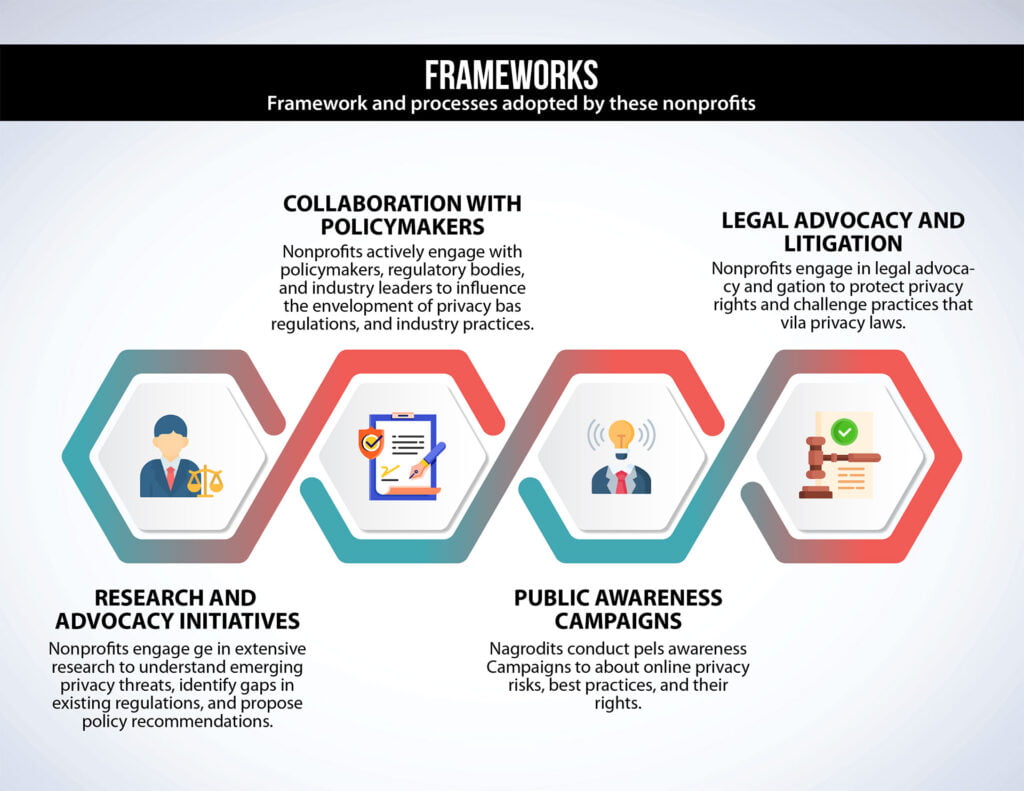
These nonprofits employ various frameworks and processes to tackle online privacy issues effectively. Here are some approaches adopted by these organizations:
1. Research and advocacy initiatives: Nonprofits engage in extensive research to understand emerging privacy threats, identify gaps in existing regulations, and propose policy recommendations. They publish reports, white papers, and research findings to raise awareness and shape the discourse on online privacy.
2. Collaboration with policymakers and industry stakeholders: Nonprofits actively engage with policymakers, regulatory bodies, and industry leaders to influence the development of privacy laws, regulations, and industry practices. They provide expertise, guidance, and recommendations to address privacy concerns adequately.
3. Public awareness campaigns and educational programs: Nonprofits conduct public awareness campaigns to educate individuals about online privacy risks, best practices, and their rights. They develop educational resources, organize workshops, and collaborate with educational institutions to promote digital literacy and responsible online behavior.
4. Legal Advocacy and Litigation: Some nonprofits engage in legal advocacy and litigation to protect privacy rights and challenge practices that violate privacy laws. They may file lawsuits, participate in legal proceedings, and provide legal representation to individuals or groups whose privacy has been compromised. Through their legal efforts, nonprofits seek to establish legal precedents, enforce existing privacy laws, and hold accountable those who engage in unlawful data practices.
Analysis of the Contribution of Nonprofits to raising awareness and resolving online privacy concerns
Nonprofits’ efforts have significantly impacted raising awareness and resolving online privacy concerns.
- Impact of research and advocacy efforts: Nonprofits’ research and advocacy initiatives have shed light on emerging privacy challenges, influenced policy discussions, and informed the development of privacy-enhancing technologies. Their expertise and research findings provide valuable insights for policymakers, industry stakeholders, and individuals seeking to protect their online privacy.
- Influence on policy development and regulation: Through collaborations and engagement with policymakers, nonprofits have influenced the development of privacy laws and regulations. Their expertise and policy recommendations have helped shape legislative frameworks prioritizing individual privacy rights and ensuring transparency and accountability in data practices.
- Effectiveness of public awareness campaigns: Nonprofits’ public awareness campaigns and educational programs have played a vital role in empowering individuals to protect their online privacy. By providing accessible information, resources, and practical guidance, nonprofits have raised awareness about privacy risks and encouraged individuals to adopt privacy-enhancing practices.
ROLE OF AMERICAN UNIVERSITIES IN ADDRESSING ONLINE PRIVACY CONCERNS
American universities are crucial in advancing research and innovation in online privacy. Below is a brief overview of universities that have significantly contributed to addressing online privacy concerns.
- Stanford University: Stanford’s Center for Internet and Society (CIS) is renowned for its research on privacy, security, and emerging technologies. The university’s interdisciplinary approach brings experts from various fields to tackle complex privacy challenges.
- Massachusetts Institute of Technology (MIT): MIT hosts several research initiatives and centers focused on privacy, including the MIT Internet Policy Research Initiative (IPRI) and the Computer Science and Artificial Intelligence Laboratory (CSAIL). These institutions drive cutting-edge research on privacy-enhancing technologies and policy implications.
- Carnegie Mellon University: Carnegie Mellon’s CyLab is a leading research center dedicated to cyber security and privacy. Its multidisciplinary approach combines computer science, engineering, and social science researchers to address privacy concerns across diverse domains.
Several other universities have significantly contributed to online privacy research, education, and awareness. Some notable examples include:
- Harvard University
- University of California, San Diego
- New York University
- University of Texas at Austin
- Princeton University
- University of Michigan
- University of Illinois at Urbana-Champaign
- Johns Hopkins University
These universities and many others have research centers, academic programs, and collaborations dedicated to studying and addressing online privacy concerns. Each institution brings unique expertise, resources, and perspectives to the field, contributing to the overall efforts to improve online privacy practices and ensure a deeper understanding of privacy-related challenges.
Framework and processes employed by Universities
American universities employ specific frameworks and processes to tackle online privacy concerns effectively.
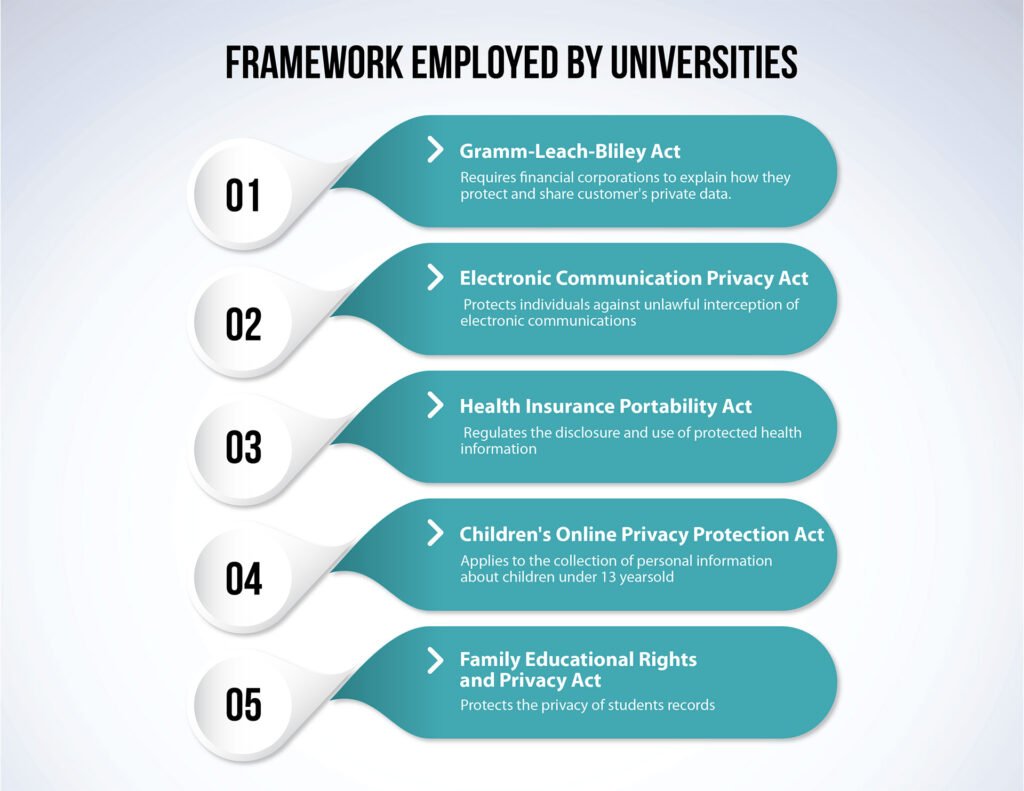
- Research centers and programs focused on online privacy: Universities establish dedicated research centers and programs focusing on privacy-related issues. These entities provide a platform for researchers to collaborate, conduct in-depth studies, and develop innovative solutions to address online privacy challenges.
- Interdisciplinary collaborations and partnerships: Universities encourage interdisciplinary collaborations, bringing together experts from various fields such as computer science, law, psychology, and sociology. By combining expertise, universities enhance their understanding of privacy issues and develop comprehensive solutions considering technological, legal, and societal aspects.
- Student involvement and education: Universities actively involve students in privacy research, encouraging participation in projects, internships, and workshops. Integrating privacy education into curricula ensures universities equip students with the knowledge and skills to contribute to privacy-conscious practices in their future careers.
- Privacy Engineering: Some universities adopt privacy engineering frameworks that focus on integrating privacy considerations into the design and development of systems and technologies. These frameworks provide guidelines and methodologies for incorporating privacy-by-design principles, conducting privacy impact assessments, and implementing privacy-enhancing measures.
- Ethical Data Governance: Universities may emphasize frameworks for ethical data governance, which involve establishing policies, practices, and guidelines for responsible data collection, use, and sharing. These frameworks prioritize protecting individuals’ privacy rights, informed consent, data anonymization techniques, and transparent data handling practices.
- Privacy Compliance and Risk Management: Universities adopt frameworks emphasizing privacy compliance and risk management strategies. These frameworks involve assessing privacy risks, implementing appropriate safeguards, and ensuring compliance with relevant privacy laws and regulations. They include processes such as privacy audits, policy development, staff training, and ongoing monitoring to mitigate privacy risks effectively.
- User-Centric Design: Universities focusing on user-centric design frameworks prioritize the development of privacy-enhancing technologies and user-friendly privacy controls. They emphasize the importance of empowering individuals to understand and manage their privacy preferences through intuitive interfaces, precise consent mechanisms, and granular privacy settings.
Evaluation of universities’ contribution to creating awareness and resolving online privacy issues
Universities’ efforts have significantly contributed to creating awareness and resolving online privacy issues.
- Advances in privacy-focused research and technologies: Universities produce groundbreaking research that pushes the boundaries of online privacy protection. Their innovative approaches lead to the development of new privacy-enhancing technologies, cryptographic algorithms, and privacy frameworks that help address evolving privacy concerns.
- Impact of academic publications and conferences: Universities publish academic papers and organize meetings that facilitate knowledge sharing and promote dialogue on online privacy. These publications and events serve as platforms for disseminating research findings, promoting best practices, and influencing the broader academic and industry communities.
- Graduates’ influence on industry practices and policies: University graduates play a significant role in shaping industry practices and procedures related to online privacy. Many alumni take key positions in technology companies, government agencies, and nonprofit organizations, driving the adoption of privacy-centric approaches and advocating for more robust privacy protection measures.
CONCLUSION
Throughout this paper, we have explored the efforts of American-based nonprofits, universities, and organizations in addressing online privacy issues. Nonprofits such as the Electronic Frontier Foundation, Center for Democracy & Technology, and Future of Privacy Forum have actively advocated for privacy rights, conducted research, and collaborated with policymakers and industry stakeholders. Universities have played a significant role through research centers, interdisciplinary collaborations, and educating students on privacy issues.
The collective efforts of nonprofits, universities, and organizations have substantially impacted raising awareness and resolving online privacy concerns. These entities have made strides in protecting individuals ‘ privacy rights through research, advocacy, policy influence, and technological innovations. They have contributed to developing and adopting privacy-enhancing technologies, influenced industry practices and best practices, and empowered consumers to take control of their online privacy.
As we look ahead, it is crucial to identify potential areas for further improvement in addressing online privacy issues. This includes:
- Strengthening privacy regulations: Continued efforts should be made to enhance privacy regulations and ensure their enforcement. Regular updates to privacy laws can keep pace with emerging technologies and address new privacy challenges.
- Promoting privacy by design: Emphasizing privacy by design principles in developing digital products and services can embed privacy protections from the outset. Organizations should integrate privacy considerations into their design processes; ensuring privacy is fundamental to technological innovation.
- Enhancing user education and empowerment: Ongoing education initiatives are necessary to raise awareness among individuals about privacy risks, rights, and best practices. User-friendly tools, resources, and guidance can empower individuals to make informed decisions about their online privacy.
Resolving online privacy challenges requires a collective effort involving nonprofits, universities, organizations, policymakers, industry leaders, and individuals. Continued awareness about the importance of online privacy and the need for robust privacy protections is vital. Collaboration and information sharing among entities can drive innovative solutions and shape policies prioritizing individual privacy. We can create a safer and more privacy-conscious digital landscape for all by working together.
REFERENCES
- Pew Research Center
Privacy on the Internet: The Evolving Legal Landscape
100 Data Privacy and Data Security statistics
State of the Connected Customer Report Outlines Changing Standards for Customer Engagement
An analytical framework for online privacy research: What is missing?
Americans Flunked This Test on Online Privacy
Protecting privacy in an AI-driven world
Maintaining the Privacy and Security of Research Participants’ Data
Privacy & Information Law Research Guide
405. Protecting Participant Privacy
Security and Privacy Research Lab
Privacy and Research Data Protection program
Carnegie Mellon University CyLab
Security and Privacy Research at Illinois
Keeping the Meta community safe and secure









[…] Privacy Research […]
[…] Privacy Research […]
[…] Privacy Research […]